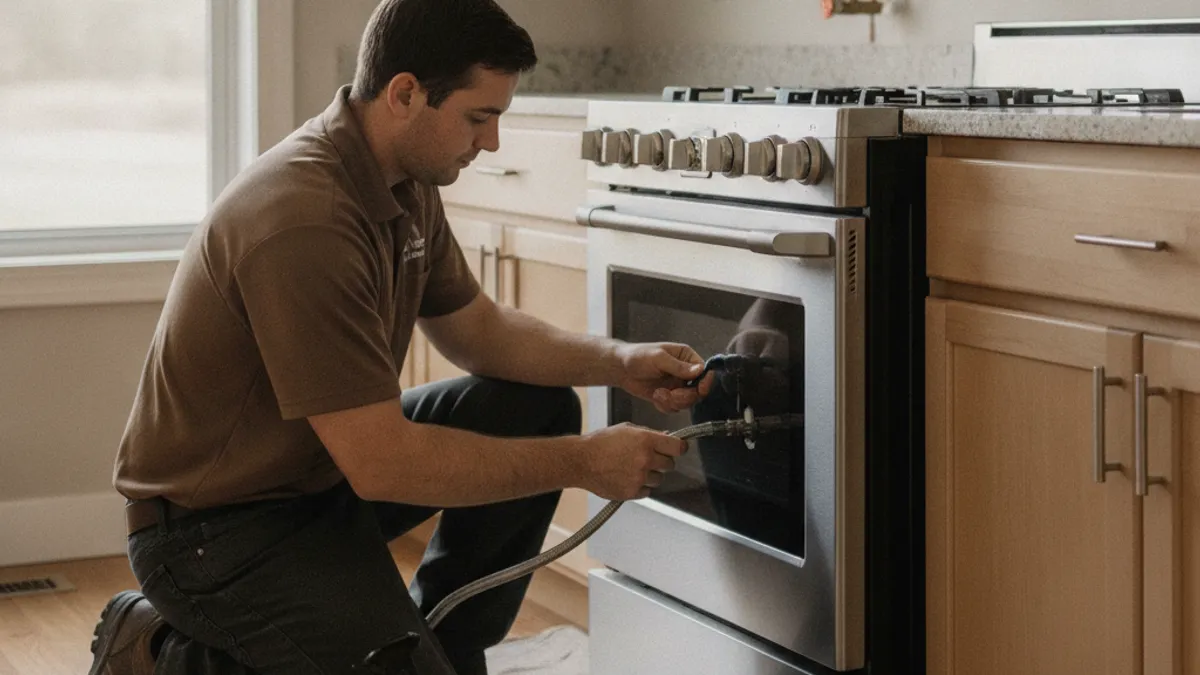
Why gas range hookups need their own conversation
A new gas range is one of the most requested appliance upgrades in a Greater Topeka kitchen remodel, and it is also the one most likely to reveal a hidden cost the initial budget did not account for. Unlike a dishwasher or disposal, gas line work sits in a different regulatory category, and it is not a task your general remodel crew should be doing themselves.
Why gas line work goes to a licensed gas fitter
Gas line installation, modification, and connection work legally requires a licensed gas fitter or plumber with gas endorsement, separate from the general contractor or remodel crew doing your cabinets and counters. This is not a formality. A gas line that is undersized, improperly sealed, or incorrectly connected is a genuine safety hazard, and it is one of the few areas of a kitchen remodel where cutting a corner has consequences well beyond a cosmetic flaw.
We coordinate this trade as part of the overall project through our kitchen appliance installation service, scheduling the licensed gas fitter alongside the rest of the remodel timeline so it does not become a separate, disconnected task you have to manage yourself.
Checking your existing gas line sizing
If you are upgrading from a smaller range to a larger, higher-BTU gas range, or from electric to gas entirely, the existing gas line may not be sized correctly for the new appliance’s demand. Gas lines are sized based on the total BTU load they need to carry, and an undersized line will not deliver adequate gas pressure to a high-output range, leading to weak burner performance even though everything looks correctly installed.
A licensed gas fitter checks existing line sizing as one of the first steps in any gas appliance installation. If the line needs to be upsized, that work typically adds $600-$1,400 to the project, depending on how much of the run needs replacement and whether it is accessible or requires opening a wall or crossing under the home.
Switching from electric to gas
Converting from an electric range to gas is a bigger scope than most homeowners initially expect. It requires running an entirely new gas line to the kitchen if one does not already exist nearby, which means coordinating with whichever utility serves your specific address and, inside Topeka city limits, pulling a permit for the new gas line installation. This work is best planned early in the remodel design phase, not decided mid-project, since the line needs to be roughed in before flooring and cabinets go down over that section of the kitchen.
Dishwasher and disposal installation
Dishwasher and garbage disposal installation fall under standard plumbing and electrical work rather than the gas fitter’s scope, but they still need to be coordinated correctly with the rest of the remodel. A dishwasher needs a dedicated supply line, a drain connection, typically tied into the disposal or a dedicated air gap, and its own electrical circuit or a properly rated outlet. A garbage disposal needs its own dedicated circuit in most current code applications and a drain connection sized to handle it.
Both are typically straightforward installs when planned as part of the original layout, running $300-$800 each including labor. They become more expensive when added after the fact to a kitchen that was not originally plumbed or wired for them, since that often means opening finished cabinetry or flooring to run new lines.
Ice-maker line installation
A refrigerator with a built-in ice maker or water dispenser needs its own dedicated water line, typically a quarter-inch supply line tapped from a nearby cold water source and run to the refrigerator location. This is a relatively minor addition when the kitchen layout is already being reworked, since the line can be run through open walls or floor before they close up, but it is a more invasive retrofit in a finished kitchen. If you are planning a refrigerator upgrade to a model with ice and water features and your current kitchen does not have this line, mention it at the design consult so it gets planned into the kitchen plumbing coordination scope rather than becoming an afterthought.
What older Topeka homes add to this scope
Homes in Central Topeka’s pre-1960 core sometimes still have original galvanized supply lines feeding the kitchen, which were never designed to support a dishwasher, disposal, ice maker, and gas range simultaneously. When we plan appliance installation for an older home in Potwin, Oakland, or North Topeka, we assess whether the existing supply capacity can actually support the full appliance package the homeowner wants, and flag it honestly if additional supply line work is needed before the appliances themselves can be installed correctly.
A realistic appliance installation budget
A single appliance hookup, a dishwasher or disposal on its own, typically runs $300-$800. A full kitchen with a new gas range requiring a licensed gas fitter, a dishwasher, a disposal, and an ice-maker line coordinated together runs $1,500-$3,500 for the installation labor alone, separate from the cost of the appliances themselves. Add gas line upsizing if your existing line cannot support a new range, and total appliance installation cost can reach $2,500-$4,500 for a full package in an older home.
Timing appliances with the rest of the remodel
Appliance lead times, especially for premium ranges and panel-ready refrigerators, often run 8-14 weeks from order. Ordering appliances early in the design phase, not after demo starts, keeps them from becoming the item that delays your final punchlist. We build appliance lead time into the overall project schedule from day one for exactly this reason.
Newer homes: a simpler starting point, with one exception
Newer construction across Southwest Topeka and growth-corridor towns like Auburn generally has modern supply lines and a panel with more available capacity, which simplifies most appliance installation work considerably compared to the older core. The one exception worth checking is whether the home was built with a gas line stubbed to the kitchen at all. Some builder-grade new construction runs all-electric to save cost, meaning a homeowner who wants to switch to a gas range in a newer home may face the same new-line installation as an older home would, just without the galvanized pipe replacement question layered on top.
Electric range and induction alternatives
Not every homeowner wants to deal with gas line coordination at all, and induction ranges have gained real popularity in Greater Topeka kitchens as a result. Induction offers gas-like responsiveness for cooking without any gas line requirement, though it does typically need a dedicated 240-volt circuit, similar to what a standard electric range requires, and induction-compatible cookware, since it will not work with all pot and pan materials. For a remodel where the existing gas infrastructure is not already in place, induction is worth a real look during the design consult rather than defaulting to gas out of habit.
Coordinating multiple trades without losing time
The reason we manage appliance installation as one coordinated scope rather than leaving homeowners to schedule the gas fitter, plumber, and electrician separately is timing. Each trade typically needs the wall and floor open at a specific point in the build sequence, gas and water lines during rough-in, electrical circuits during the same phase, and final connections only after cabinets and countertops are in place. A homeowner managing these trades independently risks a gas fitter showing up before the wall is framed correctly, or an electrician needing to return for a second trip because the appliance specs were not finalized when the first rough-in happened. Coordinating it under one project manager keeps each trade on the right day, in the right order.
Common gas and appliance questions
Can my remodel crew install the gas range themselves?
No. Gas line connection work requires a licensed gas fitter or plumber with the appropriate certification, separate from a general remodel crew. We coordinate that trade directly so it happens on schedule alongside the rest of your project.
How do I know if my existing gas line can handle a new range?
A licensed gas fitter checks the line size against the new appliance’s BTU rating before installation. This is not something to guess at or assume based on the old range working fine, since BTU demand varies significantly between range models.
Is a permit required for a new gas line in Topeka?
Inside city limits, yes. New gas line installation or modification requires a permit and inspection through City of Topeka Development Services, separate from the general remodel permit if one is also required for other work.
The bottom line
Gas range hookups, dishwasher and disposal installation, and ice-maker lines each have their own requirements, and gas work specifically needs a licensed gas fitter coordinated as its own trade within your remodel. Planning appliance installation early, checking existing line capacity before ordering a bigger range, and building realistic lead times into your schedule prevents the appliance package from becoming the thing that delays your finished kitchen.
Call (785) 000-0000 for a free in-home consult. We will assess your existing gas and water line capacity honestly and coordinate every trade your new appliances actually need.