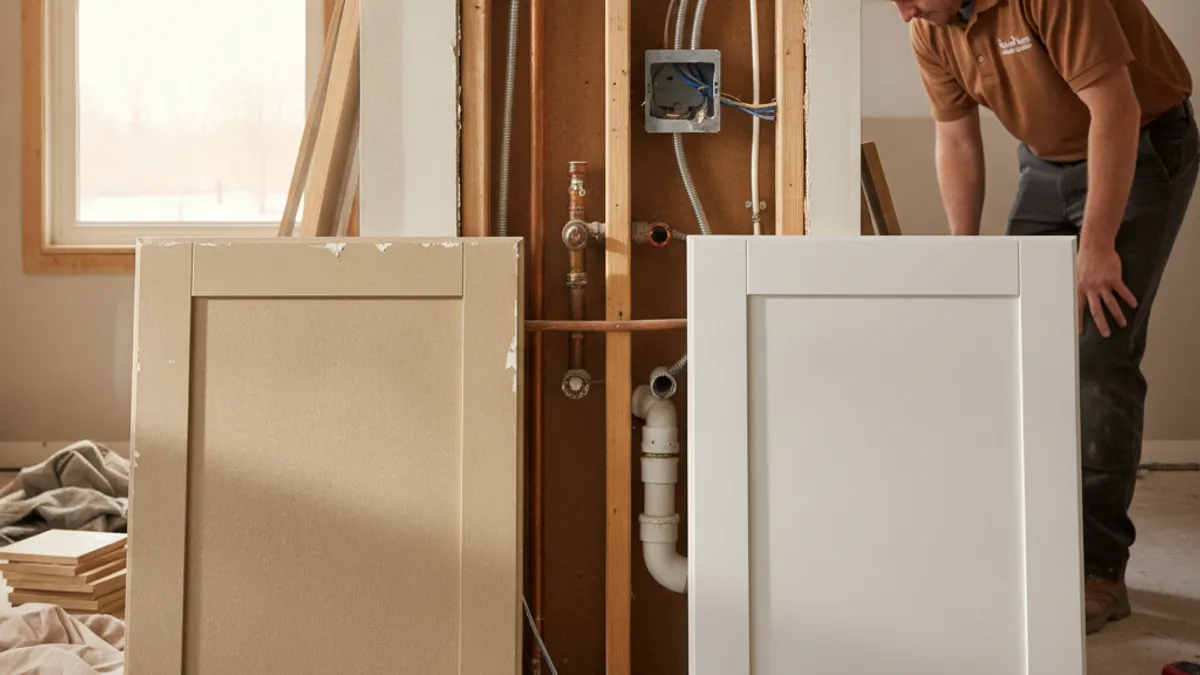
The question every kitchen remodel starts with
Before quartz counters or a backsplash come up, almost every Greater Topeka kitchen conversation starts with the same decision: reface the existing cabinets or replace them entirely. It is one of the biggest cost and timeline variables in the whole project, and it is also one of the easiest decisions to get wrong if you are working from a general rule instead of your actual kitchen.
What refacing actually involves
Cabinet refacing keeps your existing cabinet boxes in place and replaces only what you see: new doors, new drawer fronts, and a matching veneer applied over the exposed sides and face frames of the boxes. Hardware, hinges, and drawer slides are typically upgraded to soft-close at the same time. The result can look nearly indistinguishable from a full replacement, at a fraction of the cost and disruption, as long as the boxes underneath are in good shape.
Refacing runs $6,000-$14,000 in Greater Topeka and typically wraps in one to two weeks, since there is no need to demo the existing boxes or wait on a full custom cabinet build from a shop.
What full replacement actually involves
Full replacement means removing the existing cabinets entirely and installing new boxes, whether stock, semi-custom, or full custom. This is the right call when the layout itself is changing, when the existing boxes are structurally compromised, or when you want storage configurations, pull-out shelving, a larger pantry, deeper drawers, that the existing box dimensions simply cannot accommodate.
Full replacement runs $16,000-$32,000 depending on tier, and typically takes three to six weeks from final measurement to finished install, largely driven by lead time from the cabinet shop rather than the installation itself.
The condition test: what to actually check
The single biggest factor in this decision is not budget, it is box condition. Before deciding, check three things. First, open a lower cabinet near the sink and look at the bottom panel and sides for water staining, swelling, or soft spots, this is the most common failure point in an aging kitchen, especially where a dishwasher or sink has leaked slowly over years without anyone noticing. Second, check whether the boxes are square: stand back and look at whether door lines and reveals are even, since a box that has racked out of square over decades of settling will make refacing look uneven no matter how good the new doors are. Third, confirm the material: solid plywood boxes hold up far better long-term than particleboard, and a particleboard box that has taken any moisture at all is usually not a good refacing candidate.
If your cabinets pass all three checks, boxes are solid plywood, square, and dry, refacing is very likely to give you a result that looks and functions like new for a fraction of full replacement cost.
When the layout is the real driver
Box condition is not the only factor. Even a perfectly solid set of cabinet boxes cannot support a genuine layout change: moving the sink location, adding a corner lazy Susan where a straight run used to be, extending cabinets to the ceiling for more storage, or reconfiguring around a new appliance with different dimensions than the old one. If your kitchen’s problem is the layout rather than the finish, refacing will not solve it no matter how good the boxes underneath are, and full replacement, sometimes paired with our kitchen design service to plan the new layout properly, is the honest recommendation.
A decision framework
Choose refacing if your boxes are solid plywood, square, and dry, and your current layout already works for how you cook and store things. Choose full replacement if the layout needs to change, the boxes show water damage or are built from particleboard that has taken moisture, or you want storage features the existing box dimensions cannot support. If you are unsure which category your kitchen falls into, that uncertainty is exactly what a design consult resolves, since it is genuinely hard to make this call from photos or a phone conversation.
What Central Topeka’s older housing stock means for this decision
Homes in Potwin, Oakland, and the Holliday Park and Highland Park corridor often present a mixed case: original cabinet boxes from a 1930s or 1940s build that were solid wood construction and, if never damaged by water, can still be genuinely good refacing candidates decades later, even when the finish looks dated. We have refaced original boxes in this housing core that outperform some newer particleboard cabinets in structural soundness. The honest assessment happens in person, not from a guess based on the home’s age alone.
Newer Southwest Topeka homes along the Wanamaker corridor present the opposite pattern more often: cabinets from a 1990s or early 2000s builder-grade installation, frequently particleboard construction, that have simply worn out their finish and hardware faster than the higher-quality boxes in older homes sometimes did. Age alone does not predict which path is right. Construction quality does.
A hybrid approach: refacing plus targeted replacement
Some kitchens do not need an all-or-nothing answer. It is common to reface the majority of a kitchen’s cabinets while fully replacing a specific run, the section around the sink that took water damage, for instance, or adding new cabinetry for a layout change in one area while refacing everything else that is still structurally sound. Our cabinet installation and refacing service handles both approaches under one scope, so you are not paying two separate contractors to coordinate a mixed project.
Hardware and hinges: a small line item that matters
Whichever path you choose, hardware upgrades are worth doing at the same time rather than as an afterthought. Soft-close hinges and drawer slides cost relatively little to add during a refacing or replacement project, typically $15-$35 per cabinet door or drawer, but retrofitting them later as a standalone project costs more per unit and disrupts a finished kitchen a second time. Original cabinet hardware in pre-1960 Topeka homes is sometimes worth salvaging and reusing on refaced doors for a period-appropriate look, something a full replacement cannot offer since the doors themselves are entirely new.
Cost side by side
To put the two paths next to each other directly: refacing runs $6,000-$14,000 and one to two weeks, appropriate when boxes are sound and the layout works. Full stock or semi-custom replacement runs $16,000-$26,000 and three to five weeks, appropriate for a layout change with a moderate budget. Full custom replacement runs $24,000-$32,000-plus and four to six weeks, appropriate when storage needs and finish quality are the top priority. A hybrid approach, refacing most of the kitchen while replacing a damaged or reconfigured section, typically lands between the refacing and full-replacement ranges depending on how much of the kitchen needs new boxes.
Why this decision affects your overall remodel budget
Cabinets are consistently the single largest line item in a kitchen remodel, so getting this decision right has an outsized effect on the rest of your budget. Choosing refacing when it is genuinely appropriate can free up $10,000 or more to put toward countertops, a backsplash upgrade, or better appliances elsewhere in the project. Choosing full replacement when refacing would have worked just as well is one of the most common ways we see homeowners overspend on a remodel that did not need to cost as much as it did.
Common cabinet decision questions
How long do refaced cabinets last compared to new ones?
A quality refacing job, on solid boxes with new soft-close hardware, typically performs comparably to new cabinets for 15-20 years, since the structural component, the box itself, was already sound. The visible components, doors, drawer fronts, and hardware, are genuinely new either way.
Can I reface cabinets myself to save money?
Door and drawer-front replacement is within reach for a confident DIYer if the boxes are in good shape, but veneer application on face frames and box sides is where amateur attempts usually show visible seams and edges. For a kitchen you plan to live with for years, professional installation is usually worth the difference.
Is there a middle-cost option between refacing and full replacement?
Semi-custom cabinetry, which allows some dimensional flexibility without full custom pricing, sits between stock replacement and full custom, typically in the $18,000-$26,000 range for a standard kitchen, and is worth asking about if full replacement is needed but full custom feels like more than your kitchen requires.
The bottom line
Refacing works when your cabinet boxes are solid plywood, square, and dry, and your layout already fits how you use the kitchen. Full replacement is the right call when the layout needs to change or the boxes show real structural or moisture damage. The right answer depends on your specific kitchen, not a general rule based on the age of your home.
Call (785) 000-0000 for a free in-home consult. We will open your cabinets, check the boxes honestly, and tell you which path actually makes sense before recommending the more expensive option.