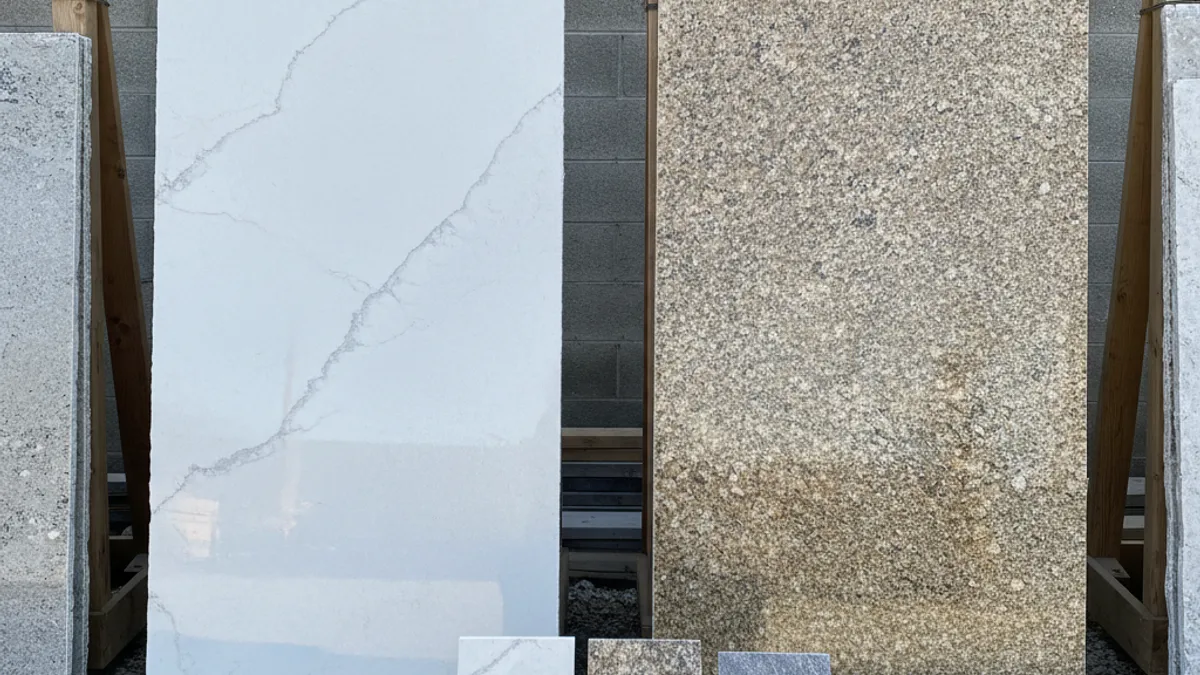
Why the “best” countertop question needs a local answer
Most countertop guides online are written for a national audience and skip the two things that actually matter in Greater Topeka: our freeze-thaw humidity swings between a humid summer and a dry, cold winter, and the hard well water common across the outlying counties like Jefferson, Jackson, Osage, and Wabaunsee. Neither factor is dramatic on its own, but together they separate a countertop that looks good for 20 years from one that needs resealing every spring or starts etching within the first year.
There is no single best material for every kitchen. The right answer depends on how you cook, whether your water is hard or soft, and how much upkeep you actually want to do. Here is how quartz, granite, and laminate perform against Kansas conditions specifically.
Quartz: the low-maintenance default
Quartz is engineered stone, made from crushed natural quartz bound with resin, and it has become the default choice for most Greater Topeka kitchen remodels for a specific reason: it is non-porous, which means it never needs sealing and resists staining from the mineral deposits hard well water leaves behind on porous surfaces over time. If your home is on a private well, common across the rural stretches of this footprint, that non-porous surface is a real practical advantage over natural stone.
Quartz also handles Kansas’s humidity swings without expanding or contracting the way some natural materials can over decades. It runs $50-$85 per square foot installed and holds a consistent, manufactured color pattern, which matters if you want your countertop to look identical from one end of the kitchen to the other, unlike natural stone where every slab varies. The one real weakness: quartz is heat-sensitive at the resin level, so a hot pan set directly on the surface without a trivet can cause discoloration over time, something granite and quartzite handle better.
Granite: durable, but needs periodic sealing
Granite is a natural stone, quarried and cut into slabs, and it remains a strong, durable choice for Kansas kitchens, particularly for homeowners who put hot pans directly on the counter or want the natural variation quartz cannot replicate. Granite handles heat better than quartz and is genuinely tough against daily wear.
The trade-off is porosity. Granite needs periodic sealing, typically once a year, to resist staining, and hard well water can accelerate mineral buildup on an unsealed or under-sealed surface. Homeowners on well water in the outlying counties who choose granite should plan on sealing on a more consistent schedule than a Topeka homeowner on city water might need. Granite runs $45-$75 per square foot installed, generally a bit less than quartz, and remains a solid value pick for kitchens where heat resistance matters more than zero-maintenance convenience.
Laminate: the budget option that still works
Laminate gets dismissed too quickly in a lot of remodel conversations. Modern laminate has improved significantly from what it was decades ago, and it performs perfectly well in a Kansas kitchen as long as heat and moisture are managed at the sink and stove specifically. It runs $30-$50 per square foot installed, by far the most budget-friendly option, and works well for a small and galley kitchen remodel or a basement kitchenette where the budget needs to stretch across cabinets, flooring, and counters together.
The weak points are real: laminate seams are more visible than a fabricated stone seam, it can scorch from a very hot pan, and moisture at an unsealed seam near the sink can eventually cause swelling. For a kitchen with careful daily use, none of those are dealbreakers. For a high-traffic family kitchen where hot pans land straight from the oven, laminate is a harder sell.
Butcher block: worth mentioning, with a caveat
Some Topeka homeowners ask about butcher block, especially for an island or a secondary prep counter alongside quartz or granite elsewhere. It looks warm and works well as an accent, but it needs real upkeep in a humid-summer, dry-winter climate: regular oiling to prevent the wood from drying and cracking during Kansas winters, and careful moisture management near any sink to prevent warping. We generally recommend it as a secondary surface rather than the primary counter for most kitchens here.
How hard well water changes the decision
If your home is on a private well, which is common across the rural stretches of Jefferson, Jackson, Osage, and Wabaunsee County, water hardness is worth testing before you commit to a countertop material. Hard water leaves mineral deposits that show up faster on porous surfaces, which pushes the decision toward quartz for most well-water households, or toward a disciplined granite sealing schedule if you have your heart set on natural stone.
Matching the material to how you actually cook
If you are the type of cook who sets a hot pan straight from the stove onto the counter, lean granite or quartzite. If low maintenance and consistent color matter more than heat resistance, lean quartz. If budget is the primary constraint and you are willing to use trivets and wipe up spills promptly, laminate remains a genuinely good option, not a compromise. Pair your material choice with the right countertop installation crew, since installation quality, especially seam placement and undermount sink cutouts, affects durability as much as the material itself does.
Quartzite: the middle-ground option
Quartzite is a natural stone, not to be confused with engineered quartz despite the similar name, and it sits between granite and quartz in terms of upkeep. It handles heat exceptionally well, arguably better than granite, and has a natural, sometimes marble-like appearance that a lot of homeowners want without the maintenance marble actually requires. It does need periodic sealing like granite, since it remains a porous natural stone, but its density generally makes it more stain-resistant than granite between sealings. Quartzite runs $65-$110 per square foot installed, on the higher end of the range, and is worth considering if you want the natural look with better heat tolerance than engineered quartz.
A side-by-side summary
For a quick comparison at a glance: quartz needs no sealing and costs $50-$85 per square foot, the strongest fit for well-water households that want zero maintenance. Granite needs annual sealing and costs $45-$75 per square foot, the strongest fit for heat-heavy cooks on a moderate budget. Quartzite needs periodic sealing and costs $65-$110 per square foot, the strongest fit for homeowners who want a natural stone look with better heat resistance than granite. Laminate needs no sealing but is heat- and moisture-sensitive at seams, and costs $30-$50 per square foot, the strongest fit for a tight budget or a secondary kitchen space.
Does material choice affect resale value in Greater Topeka?
Quartz and granite are both well understood by buyers and appraisers in this market and rarely raise questions during a sale. Quartzite reads as a premium upgrade in a listing but is a smaller market share, so it will not necessarily move the needle on price the way it might in a higher-end coastal market. Laminate is not a resale liability by itself in a mid-range home, but in a higher-value Westboro or Potwin listing, buyers in that price range typically expect stone or quartz, and a laminate counter can become a talking point during negotiations.
Common material questions
Does Kansas freeze-thaw weather actually affect indoor countertops?
Not directly, since your kitchen counter is not exposed to outdoor freeze-thaw cycles the way a foundation or driveway is. The relevant factor indoors is the humidity swing between a humid summer and a dry winter with forced-air heat running, which affects wood-adjacent materials like butcher block far more than stone or quartz.
Is quartz really maintenance-free?
Nearly. It never needs sealing, but it still benefits from using a cutting board and trivet, since the resin binder can scratch or discolor under enough direct heat and abrasion over time, even though the surface resists staining extremely well.
How do I know if granite needs resealing?
A simple test: put a few drops of water on the surface. If it beads up, the seal is holding. If it soaks in and darkens the stone within a few minutes, it is time to reseal.
The bottom line
Quartz is the strongest all-around choice for most Greater Topeka kitchens, especially on well water, because it needs no sealing and resists the mineral staining hard water causes on porous surfaces. Granite remains excellent for heat-heavy cooks willing to keep up a sealing schedule. Laminate is a genuinely solid budget option for the right kitchen. The right material depends on your water, your cooking habits, and your budget, not a single universal answer.
Call (785) 000-0000 for a free in-home consult. We bring real samples of each material so you can see and touch them against your actual cabinets before deciding.